
About This Respond AI Agent
Key capabilities
Respond AI packages the capabilities a modern response operation actually needs, from always-on discovery to a near-ready first draft.
| Capability | What it does |
| Always-on opportunity discovery | Monitors inboxes, portals, and intake queues continuously, so no request is missed. |
| Automated document retrieval | Purpose-built retrievers pull the full request package from your source systems, with fallback handling for sites requiring specialized access. |
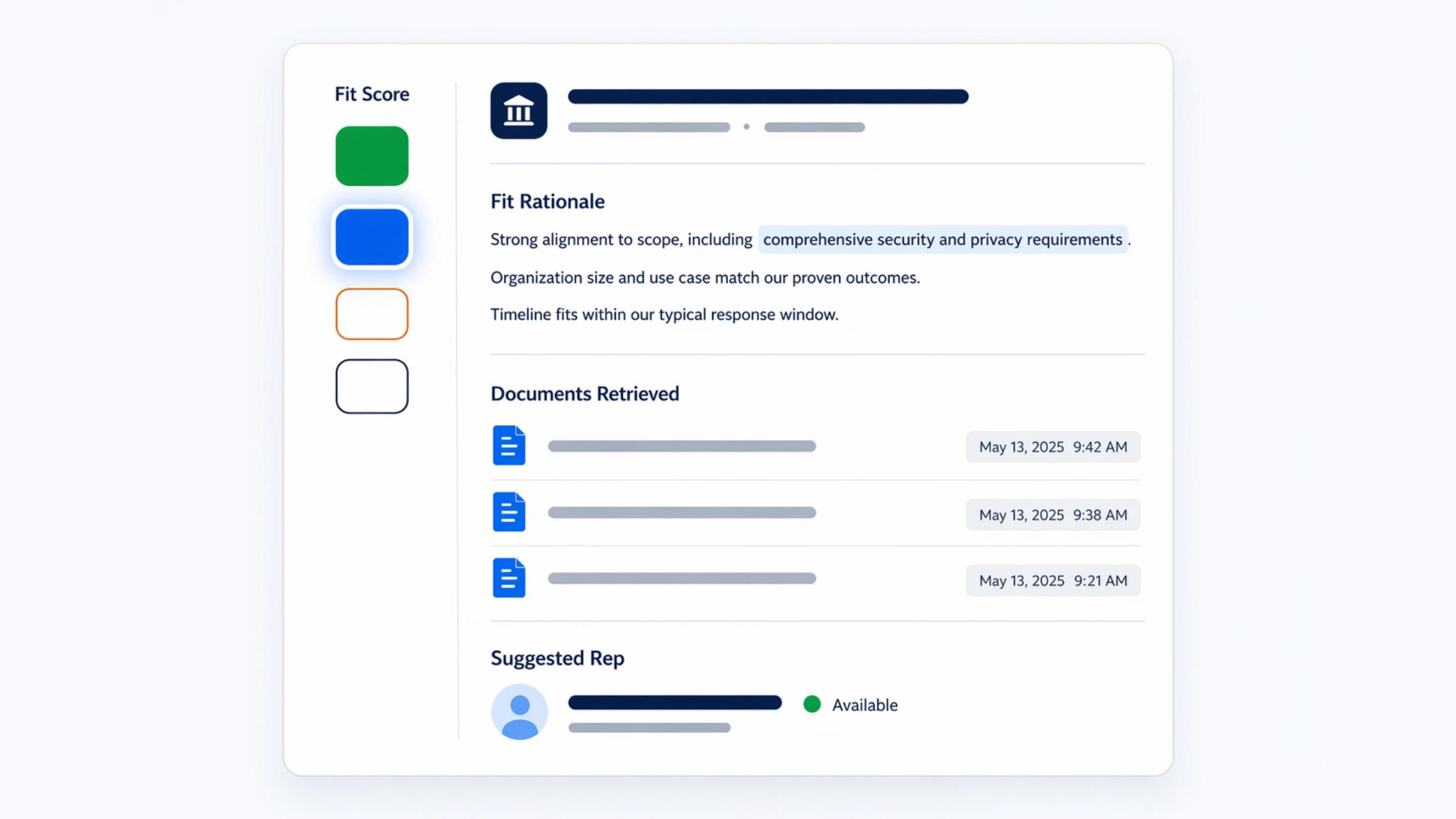
| AI fit scoring | Every item is scored across four tiers against your criteria (win profile for RFPs, policy coverage for security questionnaires, eligibility for grants, coverage and liability for claims), with a plain-English rationale citing the request language that drove the rating. |
| Near-ready drafts in the buyer's preferred format | A multi-pass drafting process produces the response in the format the recipient expects (Microsoft Word for proposals, questionnaire templates for security reviews, carrier portal forms for claims, grant narratives for funders), addressing every requirement in a consultative voice. |
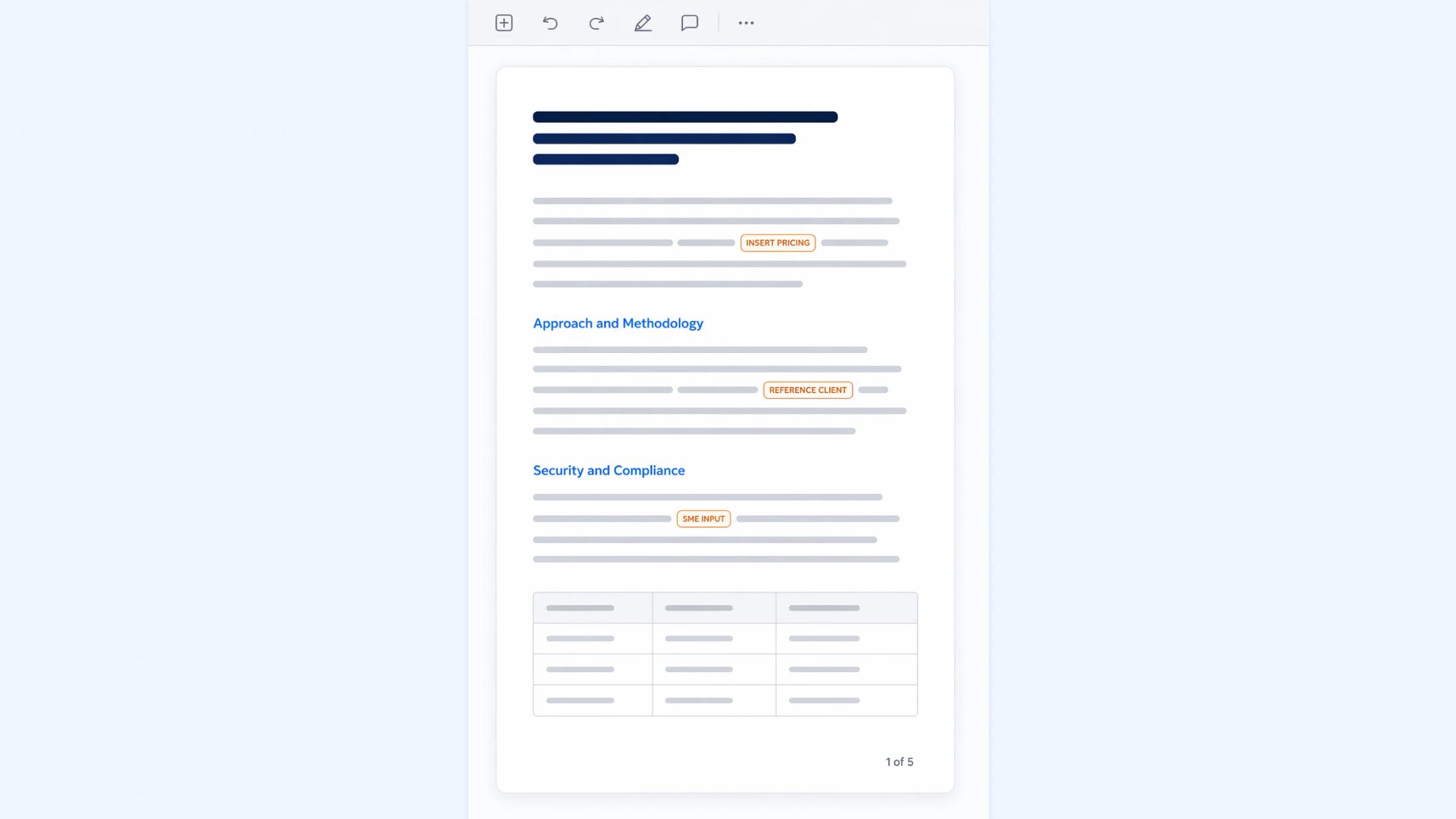
| Smart placeholders | Where the AI needs owner input (pricing, specific references, named staff, policy attestations), the draft marks each placeholder clearly. |
| Honest gap handling | For partial-fit requirements, the draft describes what you can do and proposes how the gap will be addressed, rather than overpromising. |
| Intelligent owner assignment | Each item is routed to the right owner by vertical, territory, workload, or subject-matter expertise, with summary, fit score, source documents, and draft attached. |
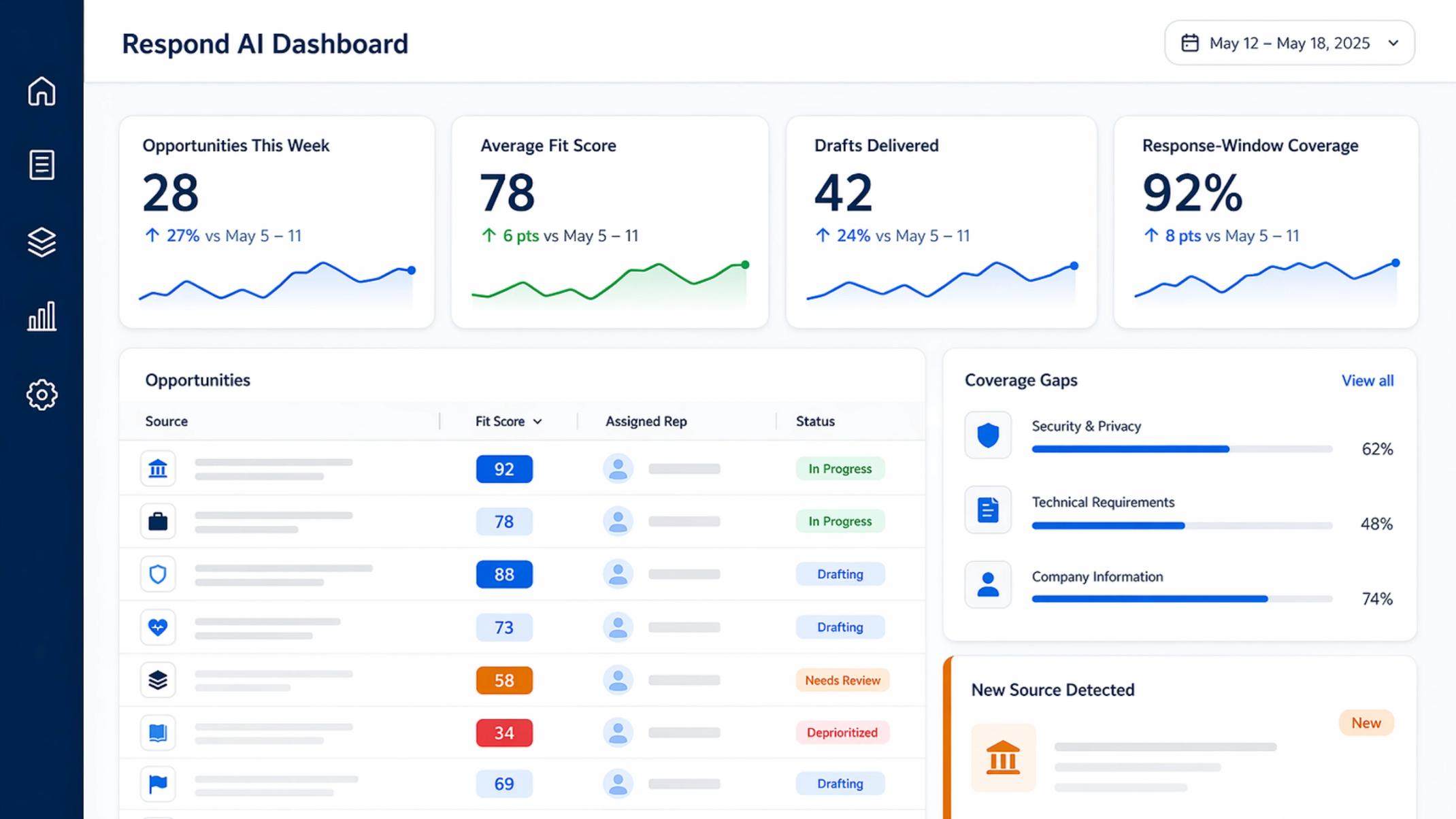
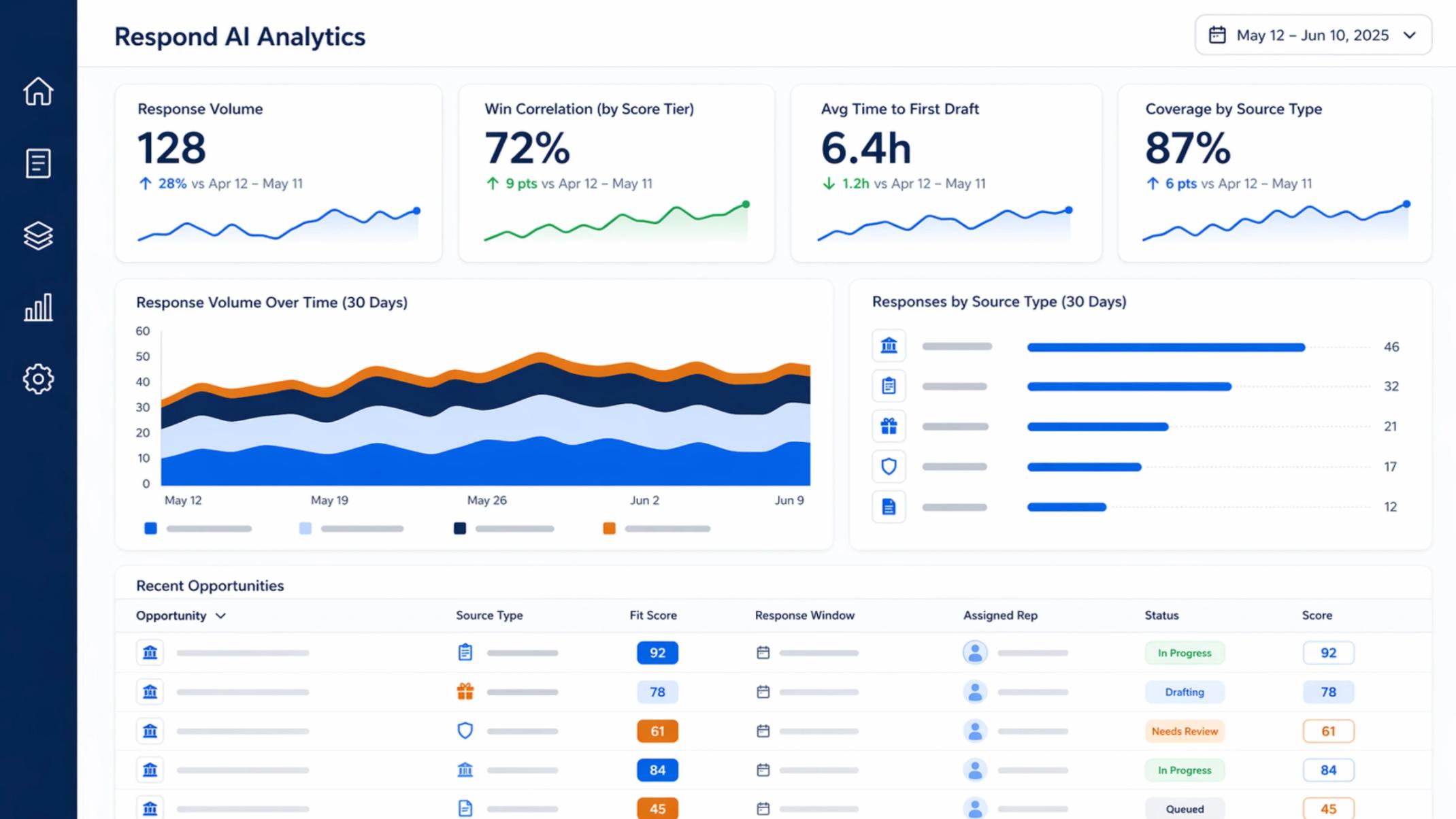
| Pipeline dashboard | A browser-based dashboard shows every item, status, score, assigned owner, retriever health, and anything needing attention. |
| Daily digest email | An automated summary lands in stakeholder inboxes every morning covering new items, scores assigned, and flags. |
| Expanding source-system coverage | New source systems (procurement portals, security questionnaire platforms, grant portals, claims systems) are added on request. Shared-software sources often onboard in minutes; new sites are flagged with a fallback so the item is not lost. |
| No per-user pricing | The pipeline runs as a managed service. No seats to buy, no licenses to provision, no incremental cost for internal viewers. |
How it works
AI RFP response is the worked example below. The same four steps apply to each adjacent workflow (security questionnaires, grants, claims, legal RFI, recruiting, vendor qualification) with minor configuration differences in the source feeds, the evaluation rubric, and the target draft format.
For your sales team
- A new opportunity lands in the pipeline. Email alerts and portal monitors feed continuously into the system. Each item is classified, deduplicated, and queued.
- The documents are retrieved automatically. The pipeline pulls the full solicitation package from the issuing portal, including amendments and Q&A attachments, and stores them in a secure cloud location.
- The opportunity is scored and assigned. The AI reads the full solicitation, scores fit across four tiers, writes a plain-English rationale, and routes the opportunity to the rep best matched by vertical, territory, and workload.
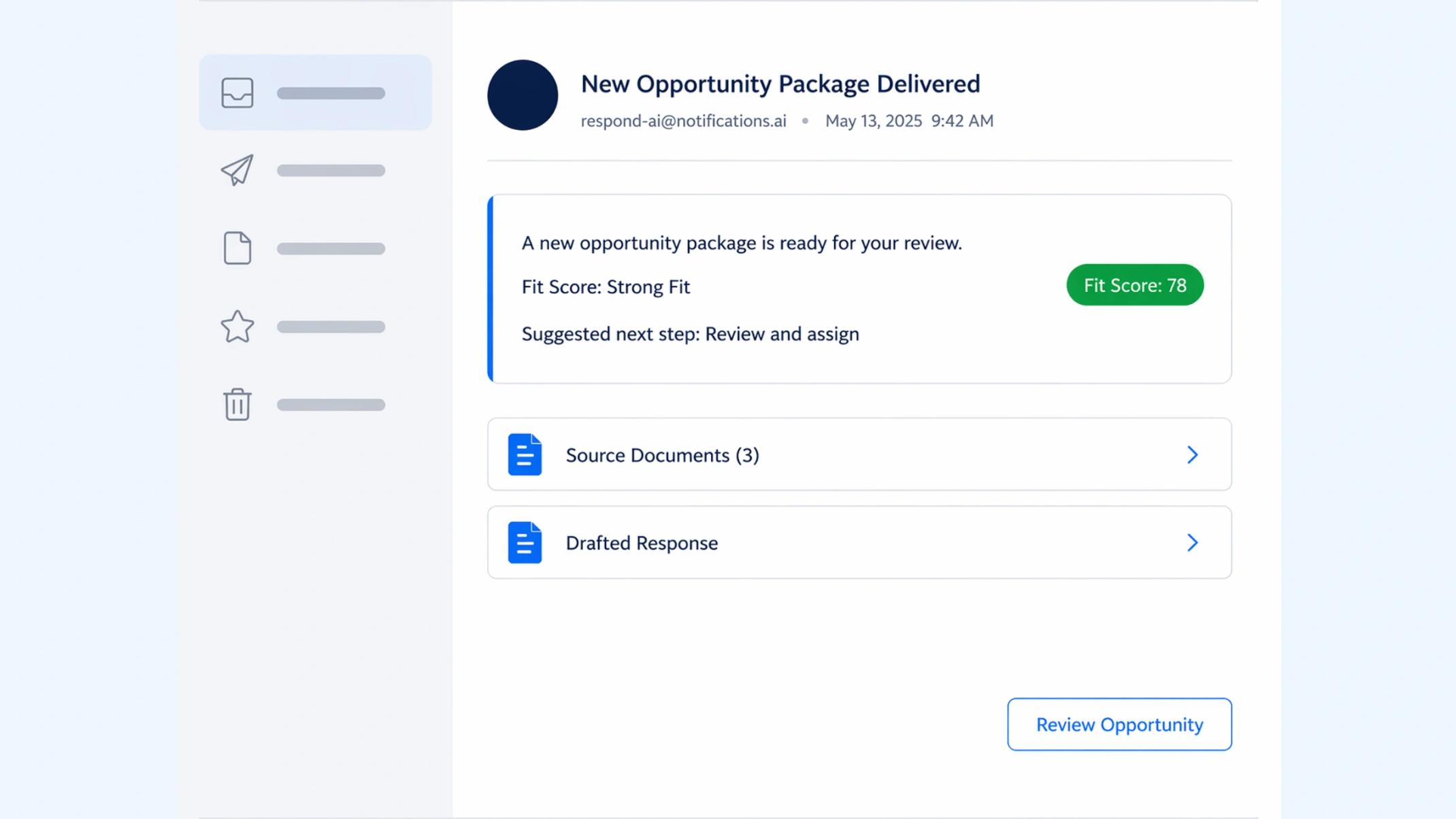
- The rep opens an email with a ready-to-review package. Summary, fit score with reasoning, links to the source documents, and a drafted Word proposal attached. The rep starts editing, not from a blank page.
For your team
- You share your inputs and target sources. For AI RFP response: win profile, target procurement portals, disqualifiers. For security questionnaires: policy library, attestation rules. For grants: eligibility rubric, funding focus. For claims: coverage rules.
- We configure the evaluation and retrieval. Caspio tunes the AI scoring, builds or enables retrievers for your target sources, and configures assignment rules.
- We ingest your capability content. We structure your case studies, policy documents, product capabilities, and standard response language so the AI drafts on your voice, not a generic template.
- We run the pipeline. Caspio operates the managed service. Your team uses the dashboard and the daily digest. Your owners receive drafts. No infrastructure on your side.
Most teams go from kickoff to live pipeline in a matter of weeks. Expansion to new sources, workflows, or scoring criteria is handled by our team without a project on yours.
Built-in value: response capacity without hiring a response team
Response work is a headcount-heavy function in every vertical it touches. A mature proposal operation carries proposal managers, capture managers, SME liaisons, and editorial support. A mature security-review function carries GRC analysts and engineers pulled off product work. A mature grants office carries writers, researchers, and compliance reviewers. A mature claims unit carries adjusters, document clerks, and triage coordinators. Industry benchmarks commonly cite the fully-loaded cost of a single competitive proposal at several thousand dollars at the low end and well into five figures for complex responses; security questionnaires, grant narratives, and adjudicated claims carry analogous per-unit costs. Multiply across dozens of items a month and the math forces an uncomfortable choice: respond to fewer, or grow the team. AI RFP response automation, and its sibling patterns across questionnaires, grants, and claims, changes the arithmetic. Respond AI absorbs the monitoring, retrieval, qualification, and first-draft work, so a small team produces the output of a much larger one. Owners focus on review, differentiation, pricing, policy judgment, coverage judgment, and the human calls that actually move outcomes.
| Interaction | Typical effort and cost profile |
| In-house response operation for comparable volume (capture team for AI RFP response, security-review team, grants writer pool, or claims adjuster pool, depending on workflow) | A multi-headcount function with fully-loaded salary, benefits, tooling, and management overhead |
| Respond AI | A small fraction of in-house response-team headcount cost, delivered as a managed pipeline, with no per-user licenses |
The effect compounds after hours. Solicitations drop overnight, security questionnaires arrive on a buyer's clock, grant windows close on weekends, and claims do not pause for holidays. The pipeline keeps discovering, retrieving, qualifying, and drafting while the team sleeps, so owners walk in Monday to a queue of ready-to-review packages instead of a week of catch-up.
Built for every response workflow
One pipeline. Every response workflow your business has to run. The same four-step loop (discover, retrieve, score, draft and route) runs continuously against whichever sources and criteria you configure.
- RFP response. The flagship workflow. Respond AI monitors public-sector and enterprise procurement portals, retrieves full solicitation packages, scores each opportunity against your win profile, drafts a proposal in Microsoft Word, and routes the package to the assigned rep. AI RFP response replaces hours of portal-hopping, blank-page drafting, and rep dispatching with a package ready for review.
- Security questionnaires. Inbound vendor and customer questionnaires are ingested from email and security-review platforms. The AI retrieves grounded answers from your policy library and past approved responses, drafts the response in the buyer's template, and flags anything needing an SME. GRC teams hand customers a faster answer and reclaim engineering hours.
- Grant applications. Funding announcements from federal, state, foundation, and corporate sources are monitored continuously. The AI scores each against your eligibility rubric, retrieves the full application package, and drafts narrative sections from your track record, programs, and impact data. Grants managers polish and submit, not draft from scratch under deadline.
- Claims intake. Inbound claims and first notices of loss are pulled from carrier portals, client channels, and email. The AI evaluates coverage and liability against your policy rules, builds an adjuster package with supporting documents, and routes the claim by line of business and workload. Claims ops move faster on triage with consistent analysis on every file.
- Vendor qualification. Incoming questionnaires from customers or primes are parsed, answered from your capability knowledge base, and returned in the required format. Exceptions are flagged for SME review. Sales and partner teams stop losing days to questionnaires that look identical from one buyer to the next.
- Legal RFI and discovery. Requests for information are tracked from intake through response. The AI retrieves referenced documents, assesses relevance, and drafts an initial response outline for counsel. Legal teams use the draft as a starting point, not the finish line of manual retrieval.
Deployment
Caspio handles implementation end to end. We configure the inbox and source-system monitoring, build or enable retrievers for your target sources, tune the AI evaluation against your criteria, ingest your capability content, and stand up the dashboard and the digest. Your team's job is to review the ready-to-ship package when it arrives.
- Managed pipeline. Caspio operates the service. No infrastructure to stand up, no integrations to maintain on your side.
- Browser-based dashboard. Accessible from any modern browser. Pipeline KPIs, item list, anything needing attention, retriever health, and the assignment view.
- Email-based delivery. Owners receive packages in their existing inbox, with the drafted response attached in the format the recipient expects. No new tool for the team to learn.
- Secure cloud document storage. Every request and its attachments are stored in a secure cloud location, accessible from the item record and from the owner's email.
- Platform integrations through REST API, Webhooks, and your preferred iPaaS, so the pipeline can feed your CRM, your data warehouse, your GRC system, your grants manager, or your claims platform of choice.
- White-glove setup. Criteria tuning, source-system configuration, content ingestion, and deployment are done for you. No project to spin up on your side.
Most teams go from kickoff to live pipeline in a matter of weeks. Expansion to additional sources, additional workflows, or new scoring criteria is handled by our team on an ongoing basis.
Security and trust
Respond AI runs on the Caspio platform, which is independently certified for HIPAA and SOC 2 Type II every year. For regulated workloads, we scope the full stack with you before deployment, including source-system coverage, document storage, AI evaluation, and the delivery path into your email and downstream systems, so the configuration meets your specific compliance requirements. Security is engineered in, not bolted on.
- Role-based access to the dashboard, the item records, and the source documents, so each user sees only what they are cleared to see.
- Audit logging across the pipeline captures who viewed, assigned, or acted on each item.
- Secure cloud storage for every request and its attachments, with access controls and retention rules configured to your policy.
- Retry and fallback logic at every stage, so a failure in one source or one document does not block the rest of the pipeline.
- Per-source rate pacing keeps the system within acceptable usage patterns for each external source, avoiding access blocks while maintaining throughput.
- Feature flags on each pipeline stage, so individual components can be enabled or disabled for testing, maintenance, or targeted operation.
- Hard spending caps on every external service mean an unexpected spike cannot run up your bill.
- Platform integrations flow through REST API, Webhooks, and your preferred iPaaS, so the pipeline fits your stack, not the other way around.
- 24x7 human support from Caspio for the platform itself.
Pricing
Custom pricing. Contact us for a quote.
Frequently Asked Questions
RFP response: how does AI RFP response scoring work? Every RFP is evaluated against your specific win profile: verticals, differentiators, compliance posture, delivery model, and automatic disqualifiers. The AI reads the full solicitation and assigns a fit score across four tiers, with a plain-English rationale citing the RFP language that drove the rating. Non-RFP workflows (security questionnaires, grants, claims) use the same scoring engine with a workflow-specific rubric in place of the win profile.
What source systems are supported? Dozens of source systems out of the box: procurement portals for AI RFP response (US state and local government, federal aggregators, education and healthcare procurement), security questionnaire platforms, grant portals, and claims systems. Shared-software sources often onboard in minutes; new sites are flagged with a fallback so nothing is lost. New sources are added on request.
Does Respond AI handle security questionnaires? Yes. The pipeline ingests questionnaires from email and review platforms, retrieves grounded answers from your policy library and past approved responses, drafts the response in the buyer's template, and flags anything needing an SME. Answers are grounded in your policies, not generic AI knowledge.
Does Respond AI work for grant applications? Yes. The pipeline monitors federal, state, foundation, and corporate funding announcements, scores each against your eligibility rubric, retrieves the full application package, and drafts narrative sections from your programs, track record, and impact data. Grants managers polish and submit instead of drafting from scratch under deadline.
Does Respond AI handle claims intake? Yes. Carrier-portal and client-channel retrievers pull inbound claims and first notices of loss; the AI evaluates coverage and liability against your policy rules, builds an adjuster package with supporting documents, and routes the claim by line of business and workload. Coverage evaluation is grounded in your policy documents, not generic AI inference.
Does a human always review before submission? Yes. Respond AI delivers a near-ready package; the assigned owner reviews, edits, approves, and submits. Nothing goes to an external recipient without owner review. During working hours, the owner opens the package and begins editing. Outside working hours, the package waits in the queue with the AI conversation and draft attached, so the owner picks it up informed the next business day.
How accurate is the draft? The draft is written from a structured knowledge base of your capabilities, case studies, policies, and standard response language, so the AI writes on your voice and references facts that are actually yours. For pricing, named references, staff names, or policy attestations, the draft inserts clearly marked placeholders instead of guessing. Partial-fit requirements are described honestly with a proposed approach to the gap.
Is it compliant? The Caspio platform underneath Respond AI is independently certified for HIPAA and SOC 2 Type II every year. Pipeline components (source coverage, document storage, AI evaluation, delivery path) are scoped case-by-case for regulated deployments. Role-based access, audit logging, and secure storage are standard.
What does it cost? Respond AI starts at $3,000 per month, with a one-time onboarding fee of $5,000. The base plan includes one response workflow, monitoring of three customer-defined sources, 10 first-draft proposals per month, unlimited users and digest recipients, and a Caspio Teams plan account. Add-ons (additional workflows, sources, drafts, CRM and notification integrations, premium support) are priced individually. Subscriptions are month-to-month with no minimum term. Full pricing details are available in the Respond AI Pricing Guide.
How fast can we launch? Most teams go from kickoff to live pipeline in a matter of weeks. The timeline depends on source-coverage scope and capability-content volume. Expansion to additional sources, workflows, or scoring criteria is handled by our team on an ongoing basis.
Can it process items from a source we do not see listed? Yes. When the pipeline encounters a new source, it flags the item and routes a fallback so you do not lose the deal, questionnaire, grant window, or claim. Our team adds the source on request, and shared-software sources often onboard in minutes.
How does this differ from a generic AI writing tool? A generic AI tool writes text. Respond AI runs the full response pipeline: finds the item, retrieves the documents, qualifies fit against your specific criteria, drafts in the recipient's required structure, and routes to the right owner. Quality comes from the surrounding pipeline: structured capability content, fit-scored context, and drafting tuned to the specific RFP, questionnaire, grant, or claim in hand.
Beyond AI RFP response, what other workflows does Respond AI run? Respond AI is a horizontal response pipeline. AI RFP response is the flagship; the same architecture runs security questionnaires, grant applications, claims intake, vendor qualification, and legal RFI today. See the "Built for every response workflow" section above.